The measuring system
PlantVital® 5000 as an instrument detecting the current state of
vegetation
1.
Introduction
The basic idea of the device
PlantVital® 5000 is to investigate the vitality of Chlorophyll "a"
containing species on the basis of the
oxygen production during photosynthesis ( primary metabolism of plants under investigation). All necessary
information about the technical data of this system as well as their detailed
description are comprised in Information Letters 01/04 and 02/04. Furthermore,
full description of the general philosophy of the measuring methods can be
found in the Information Letter 03/04 whereas the Application Letter 01/04
offers an extensive depiction of the ways in which the device can be applied.
The instances presented below will reveal that this bio-indication method is of
great significance for the future control of one of the fastest developing
problems of the modern world/environment concerning the exploitation of the
vegetation either in rural or urban areas as well as its natural resources.
Taking everything into account, it is of great importance to introduce special
means of monitoring that will turn away the danger from the natural
environment. The vegetation plays very significant role in our life as far as
our health and the aesthetics of the environment we live in are concerned.
Green areas of the city not only make the place more beautiful but they also
contribute to the reduction of harmful factors that affect the natural
environment. Furthermore, such green areas provide a special micro climate due
to reduction of air motions and sound
levels. Undoubtfully, the vegetation needs special attention and care. To great
extend this is the social and economic life of the city that has an enormous
impact on the vitality of the vegetation. Chemical substances, the impact of
micro particles in the air as well as soil pollution belong to the most basic
environmental influences. It is widely known that all factors mentioned above
very much affect the vegetation. Additionally, these modifications have a great
impact not only on the physiological as well as morphological parameters but
also on phenotype, longevity, growth and development. They reduce the
resistance of the vegetation from various harmful factors such as drought, cold
or pesticides.
2. The improvement of the air
quality
The role the trees play in the
preservation of the environment as well as in providing renewable raw material
is invaluable.
The state of trees to a great extend
depends on different factors. However, it must be mentioned that the ability to
produce oxygen varies and depends on the type of a tree.
The comparison of the oxygen
production by deciduous trees (Illustration 1) and coniferous trees (Illustration
2) enables the introduction of certain means that could considerably improve
the quality of the air in congested urban areas. (Other economic aspects have
to be also considered).
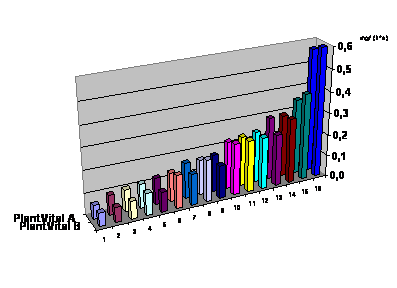
Illustration 1: The comparison of
the oxygen production "S" of some deciduous trees at comparable conditions.
1-acacia, 2-black cherry, 3-cherry tree, 4-lilac, 5-jasmine, 6-lime-tree,
7-ligusta, 8-black currant, 9-chestnut, 10-beech-tree hedge, 11-maple,
12-snowball bush, 13-rosehip, 14-willow, 15-poplar, 16-birch-tree.
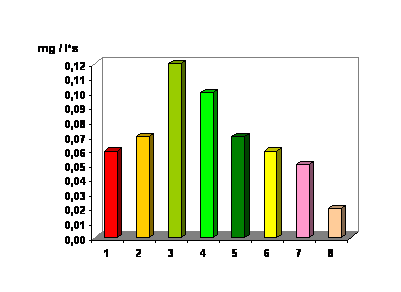
Illustration 2: The comparison of
the oxygen production "S" of different conifers at comparable conditions.
1-thuja (green), 2-thuja (blue),
3-pine tree, 4-pinus cembra, 5-spruce, 6-fir (green), 7-fir (blue), 8-larch.
3. The damage of the avenue trees in
urban areas
Illustration no.3 presents the
findings of investigations carried out on the species of trees that were
suspected of suffering. By means of the measurements made by the PlantVital®
technology, the minor damages of at the first sight sound trees (tree 3) as well as very strong impacts on
the efficiency of the photosynthesis (tree 4,5). As a comparison two trees
derived of any damages were used in the research (tree 1,2). In the case of trees
4 and 5 subjective evaluation revealed only minor alterations. However, in the
case of the tree no.3 no changes were observed. More advanced research showed
some minor diminutions in the underground gas conveying that were the basic
cause for the damages. After removing the damages the trees were able to come
to their normal state after 2 years.
The new bio-indication method may
very much contribute not only to the monitoring and controlling of the process
of exploitation of the landscape and its natural resources but may also be an
indicator for the introduction of certain means of monitoring in the state of
overcoming the values of tolerance and protect the environment from the danger
resulting from it.
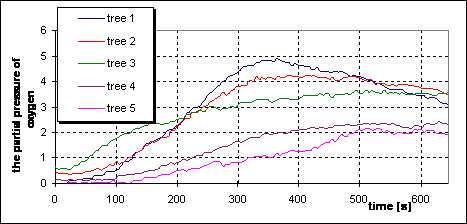
Illustration 3: The power of
photosynthesis of the lime-trees detected by means of the PlantVital®
method.
4. The research on the pines in the
open air areas
In cooperation with the Institute
for Forest Genetics and Forest Tree Breeding biological populations of pine
trees were investigated. The plant material for the research came from two test
facilities of the Institute for Forest Genetics and Forest Tree Breeding (the
tree nursery Waldsieversdorf and clone tree archive in the research area). The
test conditions are relatively homogenous. The investigation of the individual tree in the 4 samples
collecting points (N-North, O-East, S-South, W-West) and in two age groups of
needles (2003, 2002) show relatively minor deviation. It accounts for all the
measurements over 8,6 %. Among the two age groups of the needles no difference
is observed. This is the exposition that plays the most important role here.
The needles on the southern side were the most effective in the oxygen production
(proved). Other directions did not differ at all. The comparison of the values
of the needles from the tree in comparable age shows only minor deviations,
which means that he needles of a tree with the similar position act in the same
way.
The comparison of the oxygen
production of needles that come from different places of the test branch showed
small diversities. The alteration of the needle's colour is various and depends
on the type of genes. Plants of the same descendents (similar genotype, the
same parent trees) act similarly.
The highest values were measured
only in the case of needles located in the middle of the branch. The lowest
values however were obtained in the case of needles on the top of the same
branch. One can conclude that the youngest needles are very much affected by low
temperatures. The value's fall at the end of the branch indicates the old types
of needles with the regressing photosynthetic activity. The comparison of the
oxygen production of various individual trees shows significant differences.
The plants under investigation are of different origins which means, they have
different parent trees as well as the genotype.
The findings provided by comparable
investigations of other individual species of one descendants (Chinese
cross-breeding) shows the great variety. On one hand, one is able to find
descendants that give homogenous results (minor deviation of the value of individual
trees). As far as the full-siblings (the same mother and father) are concerned
these minor diversifications can be easily explained. However, individual trees
of the descendents 13 and 14 (Illustration 4) reveal very diversified values
and what follows it, the middle value characterizes an appropriate
diversification. The situation described above concerns the half-siblings that
possibly indicate the higher genetic variety within the descendents.
At this point, the relation between
the yellowish discolouring (stains, stripes) or necrosis and the oxygen
production can be obtained. Branches with symptoms of damages produce only
slender amounts of oxygen. These symptoms were partially caused in summer due
to damage stimulators such as plant louses (necrosis).

Illustration 4: The comparison of
the oxygen production "S" of different pine trees. (No. 13, 14,..- description
of the descendants according to the tree nursery in Waldsieversdorf)
In terms of the pine trees, it is
indicated that the deviations of an individual tree or among certain
populations are not bigger than the whole dispersion (the feature of an oxygen
release can be used to define a certain plant material).

Illustration 5: The comparison of
the oxygen production of different trees among the same descendants. (Numbers
13, 23 description of the same descendants according to the tree nursery in Waldsieversdorf,
1, 2 .- number of a tree among the descendants).

Illustration 6: The comparison of
the oxygen production "S" at different pine needles from the Clone-archive. (Gl
19.,Bor 9.- the tree description in the Clone - archive).
5. The
investigation of in - vitro shoots
In cooperation with the Institute
for Forest Genetics and Forest Tree Breeding the investigations of different
biological populations of trees were carried out.
The first run aimed at finding some
differences in the photosynthesis-activity of in-vitro shoots in differently
configured cultivation time and some information about the activity level of
various types of trees under investigation.
The examined material used in the
research included in-vitro shoots from which two samples of every type
were examined. Species of trees under investigations were: Betula pendula
var.carelica, Robinia pseudoacacia, Fagus sylvatica and Quercus robur. Biological populations used in the research
were provided with the fresh nutrient solution for either a very short or
longer period of time. The oxygen production was measured on the basis of two
young and full developed leaves from the Erlenmeyer flasks. Due to three
measurements the middle value as well as the standard deviation were formed.
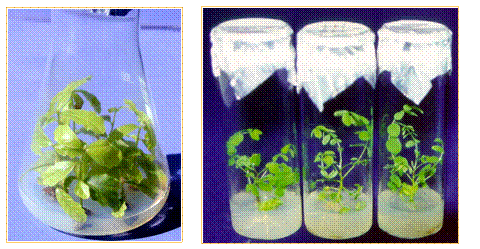
Illustration 7: Quercus robus Illustration 8: Robinia pseudoacacia
Findings: Due to the research it was
found that in all targets and types of trees under investigation there is a
significant difference between the relatively fresh biological populations and
those that have been provided with the nutrition for longer period of time.
Conclusions: The measurements of the
oxygen production of in-vitro biological populations of various trees'
types show a great spectrum of interesting findings that can be put under further
and more detailed examination with the use of other targets and after longer
preparation.
It is of some importance to examine
how does the run of the photosynthesis- activity of shoots looks like over the
period of cultivation time in order to find out whether the currently held
period of sub-culture time which means, from 4 to 5 weeks for deciduous trees
and 6 weeks for the conifers is really optimal.
Previously, the specified periods under discussion relied mostly either
on wide references or many years' observations of the in-vitro biological
populations of various trees' types.
|
Lfd. Nr. |
Type of a tree |
Clone |
The last nutrition change |
remark |
|
1 |
oak tree |
NL 100A |
25.07.03 |
|
|
2 |
oak tree |
NL 100A |
07.10.03 |
|
|
3 |
birch |
2/97 |
15.09.03 |
|
|
4 |
birch |
2/97 |
29.10.03 |
|
|
5 |
birch |
BB24 |
16.09.03 |
|
|
6 |
birch |
BB24 |
29.10.03 |
|
|
7 |
beech-tree |
Gh12 |
01.08.03 |
|
|
8 |
beech-tree |
Gh12 |
09.10.03 |
|
|
9 |
beech-tree |
9193/9 |
08.10.03 |
|
|
10 |
locust |
2439 |
25.07.03 |
|
|
11 |
locust |
2439 |
25.09.03 |
|
|
12 |
locust |
2499 |
03.06.03 |
|
|
13 |
locust |
2499 |
29.07.03 |
|
|
14 |
locust |
2444 |
09.10.03 |
normal Shoots |
|
15 |
locust |
2444 |
09.10.03 |
glassy Shoots |
|
16 |
locust |
2498 |
22.10.03 |
normal Shoots |
|
17 |
locust |
2498 |
22.10.03 |
normal Shoots |
Table 1: Samples from in-vitro
shoots

Illustration 9: The comparison of
the oxygen production "S" of different trees' types (In-vitro shoots) in
various cultivation time periods. (N1100A., 2/97.,BB24..- description of the
trees' types in the Clone-archive, a,b - repeated run, 25.07...- date of the
set in of biological populations into the nutrition).
6. The investigation of the street
trees at different urban sites
With a view to determining the
quality of life in urban areas some investigations of the air quality are being
carried out (see also the appropriate EU Directive).
The measurements of the air quality
enable the record of the actual state value to the time of measuring. However,
even though the actual vegetation period is dominant, the long-term plants in
the same region (trees and bushes) tend to store the impacts of the past
vegetation period. Due to the measurement of the parameters of vitality of the
species mentioned above it is possible to illustrate what kind of ecological
damage the region is concerned with over a period of time.
Furthermore, the measurements
provide very important data about the impact of damages that have battered the
vegetation for a very long time. The three diagrams presented below demonstrate
the comparison of the vitality "S" of lime-trees from two sites: Berlin and
Strausberg.
The site Berlin is marked by heavy traffic, commuter and mainline passenger system, railway, transportation of cargo and public transport whereas the site Strausberg is characterized as an area with conditions of a spa region.
The following illustrations (11 and 12) present the parameters of
vitality of the chestnut tree that was infested by Camerania ohidella.
Thus it appears that in more favourable areas the resisting power of trees to
damages is bigger.
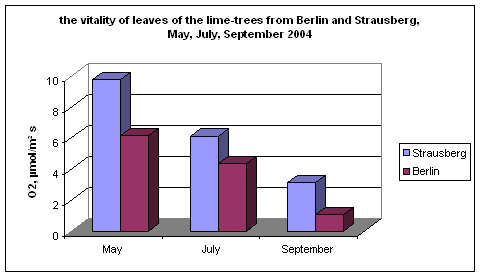
Illustration 10: The comparison of
vitality values "S" of the lime - trees in Strausberg and Berlin
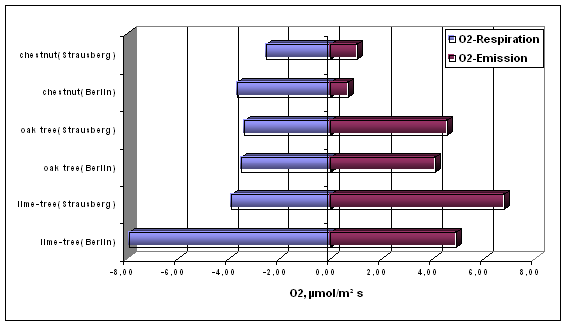
Illustration 11: The comparison of
vitality values "R" (Respiration) and "S" (Emission), presented in the case of
chestnut, oak trees and lime-trees in different urban regions (Berlin and
Strausberg).
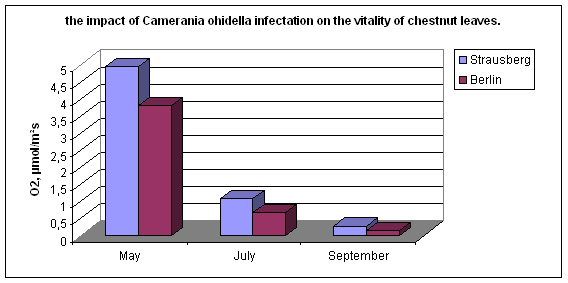
Illustration 12: The presentation of
the resisting power of chestnut to the Camerania ohidella infestation
according to the site (Berlin and Strausberg).
7. The comparison of the measuring
methods of photosynthesis of some plant - classes
The plants' signals during their
primary production can be obtained either with help of the measurement of
fluorescence or trough the detection of the oxygen- and the CO2 balance.
Because of the fact that in all three cases the procedure of investigation and
the stage of the process are different, it is of great interest to compare
these measuring methods. In terms of CO2 measurements, several
industrial measuring systems are already available offering an extensive
informative literature that give an insight into this method. In the latter
cases, however, only few references are available. The table below presents the
comparison of the two methods mentioned above (in accordance to certain
references): the values for the CO2 measurements (literature) and
the middle values for the oxygen measurements (the data provided by the company
Inno-Concept GmbH).
|
plants |
CO2-intake |
O2-emission |
|
|
µmol/m²
s |
µmol/m² s |
|
|
(references) |
(measured value) |
|
C4-plants: |
||
|
corn |
15 - 54 |
15,7 - 29,1 |
|
C3-plants: |
||
|
|
|
|
|
economical
plants |
4,4
- 35 |
4,4
- 29,6 |
|
winterwheat |
10,5
-18 |
9,0
- 12,14 |
|
deciduous
tree |
6,0
- 15,0 |
6,2
- 15,5 |
|
conifers |
3,0
- 10,8 |
3,2
- 8,25 |
Table 2: The comparison of the
measuring methods of photosynthesis of some plant-classes presented in the form
of values of the CO2 intake
(references) and the O2 emission (individual measurements).